Treadmills
Horizon T202 review
The cheapest honest way onto a full-length 60-inch belt from a brand that services its machines — and the warranty line you should read before you buy.
Belt & Bike earns a commission when you buy through our links, at no extra cost to you. Prices come from Amazon and change; the date beside every price is when we last verified it. Full disclosure.
Quick picks
| # | Model | Motor | Score | Price |
|---|---|---|---|---|
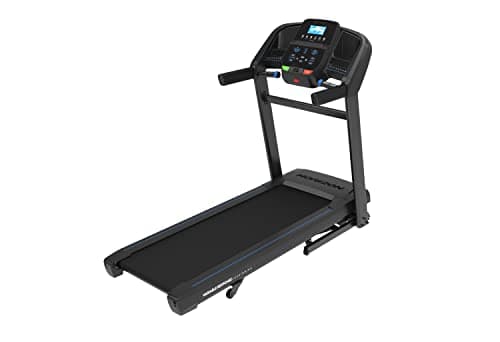
| Rank 1 | Horizon T202 The step up to a 60″ belt | 2.75 CHP | 8.0 | $799.00Amazon |
#ad Prices come from Amazon and change. How this site is funded. Scores are our published editorial rubric — see our methodology.
The T202 exists to answer one question: how cheaply can you get onto a full-length 20″ × 60″ deck without buying from a brand that will not exist in three years? Most machines in its bracket answer by shortening the belt to 55 inches and hoping you do not measure. Horizon answers by giving you the full 60 and taking the money out of the motor, the incline range and the parts warranty instead. Whether that is a good trade depends entirely on what you are going to do on it.
The published specification
Horizon publishes a 20″ × 60″ running surface, 0-12% powered incline, a 0.5-12 mph speed range, a 325 lb weight capacity, 3-Zone Variable Response cushioning and one-step hydraulic folding. The console is a 5″ LCD with three LED windows. Assembled it measures 76″ × 34″ × 57″ and weighs 187 lb; folded it is 48″ × 34″ × 62″. The motor is a 2.75 CHP continuous-duty unit. The warranty is lifetime on the frame and motor, one year on parts and one year on labor.
- 2.75 CHP is a continuous rating, not a peak one, which already puts it ahead of every treadmill advertising "4.0 HP" at half the price. It is genuinely comfortable for walking and mixed use, and it is marginal for daily running — see how much horsepower a treadmill needs for where the 3.0 CHP line sits and why.
- 20″ × 60″ is the full standard, not a near-miss. It contains a running stride for most people up to roughly 6'2″, and it is the single spec most often quietly cut at this price.
- 0-12% incline is the clearest place the money was saved. The machines a step up reach 15%, which matters more than it sounds: incline is the cheapest way to make walking genuinely hard without adding impact.
- 187 lb assembled is light for a 60-inch machine. That is a real advantage getting it into a room and a small disadvantage at pace, where frame mass is what stops a deck feeling lively.
- 325 lb capacity leaves a 225 lb runner the roughly 100 lb of margin we think running demands. Weight capacity explained sets out why static ratings and running loads are different numbers.
Three-zone cushioning is the feature worth having
Horizon's 3-Zone Variable Response deck is firmer at the push-off end and softer where your foot lands, which is the right way round and the opposite of what a uniformly soft deck does. A deck that is soft everywhere absorbs the energy you are trying to put into the belt and makes a run feel like jogging in sand; a deck that is hard everywhere transmits every footstrike into your shins.
This is a real differentiator against both the cheaper Horizon T101 and, interestingly, against the more expensive 7.0 AT, whose deck is firmer. If joint comfort is the deciding factor rather than outright capability, the T202 is the better-feeling machine of the three. Treadmill deck cushioning explained covers why zoning works.
The warranty line you should actually read
Lifetime frame and motor coverage is excellent and genuinely reassuring — those are the parts that are expensive and the parts a manufacturer will only insure if it expects them to last. But parts coverage is one year, where the Sole F63 and Horizon's own 7.0 AT both carry three.
Read a warranty as a durability forecast rather than as an insurance policy, because that is what it is: the manufacturer is telling you how long it expects the consumable electronics, rollers and console to go without a claim. One year is not alarming on a walking machine. On a machine you intend to run on five days a week, the difference between one year and three is the difference between the two tiers, and it is reflected in the price. How long treadmills last works through which components actually fail first.
What it does well
- It gets you the full belt. For a walker who occasionally jogs, or a household where one person runs and another walks, 60 inches removes the single biggest frustration of budget treadmills — running out of deck.
- It folds properly. One-step hydraulic folding is the mechanism people actually use daily, as opposed to the stiff manual latches that mean a treadmill never gets folded after the first week.
- It is honest about Bluetooth. The console transmits metrics to the Peloton app and other training apps over standard Bluetooth. You are not locked into anything, and nothing on the console stops working if you never pair it.
- It is serviceable. Horizon Fitness is owned by Johnson Health Tech, a large manufacturer with a real parts organization — which, since the 2024 bankruptcy of BowFlex, also owns Schwinn. The practical meaning is that a roller or a console for this machine is a phone call, not a forum search.
What it does not
- It is not a dedicated running machine. 2.75 CHP and one year of parts cover say so. If you run four or more times a week, the step to 3.0 CHP and three-year parts is the right one — the best treadmills under $1,000 is where that tier starts.
- 12% incline caps what you can do walking. The whole point of incline on a walking machine is to raise intensity without impact, and 15% is meaningfully harder than 12%. If incline walking is your plan, treadmills with incline ranks on exactly that.
- The console is an LCD with LED windows, not a screen. We think that is the correct trade at this money, but it is a visible difference next to iFIT machines at the same price and you should know that before it arrives.
- It still needs a room. 76 inches long plus the 24 inches of fall-off clearance behind it that every treadmill needs means a floor run of about 100 inches. Folded it is a 62-inch-tall object. Space planning and folded footprint has the measuring routine.
The subscription position
There is nothing to subscribe to. Horizon does not gate incline, speed, programs or any console metric behind a plan, and the Bluetooth broadcast goes to whichever app you choose — Peloton, Zwift, a free tracker, or none. That is the whole reason this brand keeps appearing on treadmills without a subscription. Against an iFIT-based machine at the same price, three years of avoided membership is a larger number than the price gap between the two treadmills; subscription costs explained does that arithmetic properly.
The verdict
#1 · The step up to a 60″ belt
Horizon T202
Horizon Fitness2.75 CHP and a full-length 20″ × 60″ deck with three-zone cushioning — the cheapest way onto a 60-inch belt from a brand that services its machines.
| Motor | 2.75 CHP |
|---|---|
| Running surface | 20″ × 60″ |
| Incline | 0–12% |
| Top speed | 12 mph |
| Weight capacity | 325 lb |
| Cushioning | 3-Zone Variable Response |
| Assembled weight | 187 lb |
| Subscription | Subscription optional |
No required plan. Console metrics and incline work standalone.
Specifications per Horizon Fitness published specifications.
What it does well
- 60″ belt at a price most rivals reserve for 55″
- Three-zone cushioning is firmer at push-off and softer at footstrike, which is the right way round
- 187 lb assembled is light for this class — easier to get into a room
Where it falls short
- 12% maximum incline, where the better machines reach 15%
- LCD console with LED windows, not a screen
- 2.75 CHP is fine for mixed use and marginal for daily running
Our rubric
- Motor
- 7.0
- Deck
- 9.0
- Incline
- 7.0
- Build
- 8.0
- Value
- 9.0
How it compares to the obvious alternatives
| Horizon T202 | Horizon T101 | Horizon 7.0 AT | |
|---|---|---|---|
| Motor | 2.75 CHP | 2.5 CHP | 3.0 CHP |
| Belt | 20″ × 60″ | 20″ × 55″ | 20″ × 60″ |
| Incline | 0–12% | 0–10% | 0–15% |
| Parts warranty | 1 year | 1 year | 3 years |
| Best for | Walk and jog, full belt | Walking on a budget | Running and intervals |
Against the T101, the T202 buys you five more inches of belt, two more points of incline and the three-zone deck — the single most worthwhile step inside the Horizon range if you will ever jog. Against the 7.0 AT, you are giving up 0.25 CHP, three points of incline, two extra years of parts cover and the QuickDial interval controls, and saving real money for it. Against the Sole F63, you are giving up the 3.0 CHP motor and the three-year parts term and saving a similar amount.
Who should buy it, and who should not
- Buy it if you will mostly walk, sometimes jog, want a full 60-inch belt and a fold that you will genuinely use, and prefer a serviceable brand to a bigger number on a no-name spec sheet.
- Buy [the T101](/treadmills/reviews/horizon-t101) instead if you are certain you will only ever walk. The 55-inch belt is enough for walking and the saving is substantial.
- Buy [the 7.0 AT](/treadmills/reviews/horizon-7-0-at) or [the Sole F63](/treadmills/reviews/sole-f63) instead if you run regularly. 3.0 CHP and three-year parts cover exist for a reason.
- Buy a walking pad instead if what you actually want is steps while you work. Treadmills for walking will save you most of this machine's price.
Frequently asked questions
Is the Horizon T202 good for running?
What is the Horizon T202 motor size?
Does the Horizon T202 require a subscription?
How much space does the Horizon T202 need?
What is the Horizon T202 warranty?
Horizon T202 vs T101 — which should I buy?
Sources
Read next
Treadmills
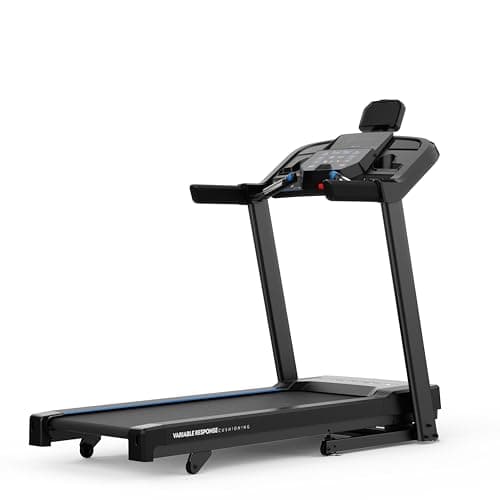
Horizon T101 review
A lifetime frame warranty and a real service network, on a machine built for walking.
Treadmills
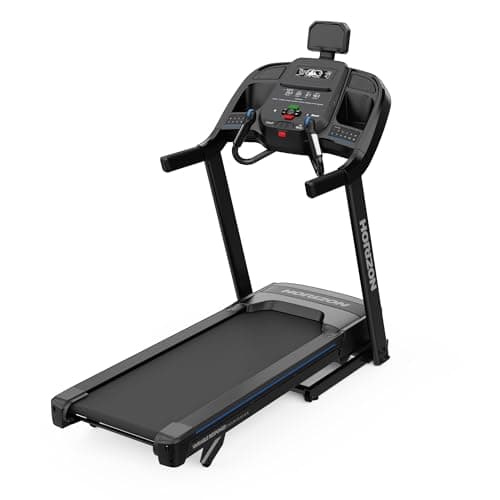
Horizon 7.0 AT review
Spec-for-spec with the F63, plus the best interval controls at the price.
Treadmills
Best home treadmills under $1,000
3.0 CHP, a 60-inch deck and a lifetime frame warranty — all available under four figures.
Treadmills
Best treadmill for walking and running at home
The narrow specification that genuinely serves a walker and a runner in one machine.
Treadmills
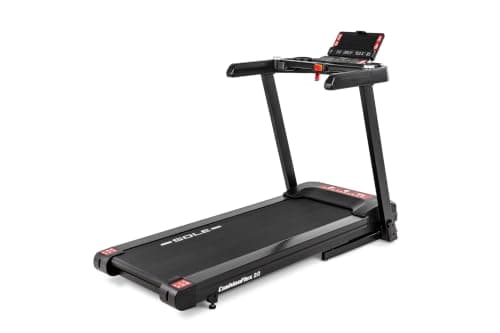
Home treadmill reviews
Model-by-model write-ups, with an explicit statement of what we verified and what we did not.