Guides
Exercise bike flywheel weight explained
Flywheel mass smooths the pedal stroke. Past about 45 lb it does nothing — and on a cheap bike it is often a distraction.
Belt & Bike earns a commission when you buy through our links, at no extra cost to you. Prices come from Amazon and change; the date beside every price is when we last verified it. Full disclosure.
Quick picks
| # | Model | Flywheel | Score | Price |
|---|---|---|---|---|
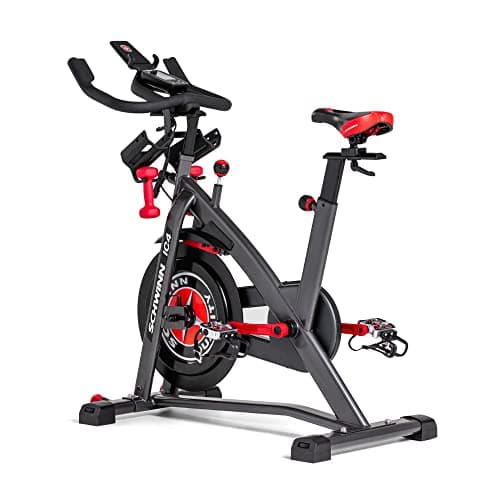
| Rank 1 | Schwinn IC4 A Peloton ride feel with no Peloton bill | 40 lb | 9.0 | $795.99Amazon |
| Rank 2 | 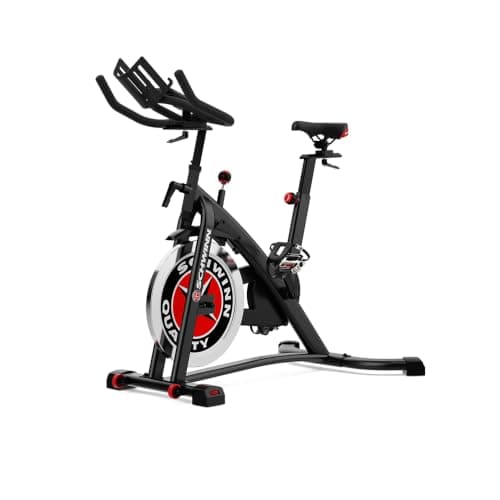 Schwinn IC3 The same flywheel, two hundred dollars cheaper | 40 lb | 7.8 | $599.99Amazon |
| Rank 3 | 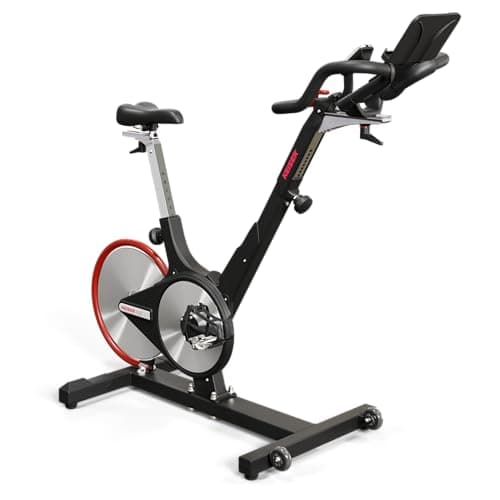 Keiser M3i The bike commercial studios actually buy | Rear-mounted, shielded from sweat | 8.6 | $2,985.00Amazon |
| Rank 4 | 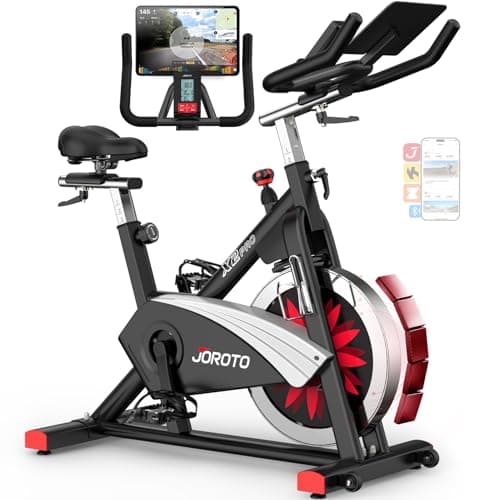 JOROTO Magnetic Exercise Bike A heavier budget spin frame | Not published | 7.8 | $399.99Amazon |
#ad Prices come from Amazon and change. How this site is funded. Scores are our published editorial rubric — see our methodology.
Flywheel weight is the headline specification in spin bike marketing, and it is widely misunderstood in both directions. Understanding what it actually does takes two minutes.
What the flywheel does
Your pedal stroke is not smooth. You produce most of your force in the downstroke, roughly from one o'clock to five o'clock, and very little through the top and bottom of the circle — the 'dead spots'. A heavy flywheel stores rotational energy during the power phase and releases it through the dead spots, which is what makes the pedaling feel continuous rather than pulsed.
That is the whole mechanism. It smooths the stroke. It does not add resistance, it does not make the workout harder, and it does not improve fitness.
The useful range
| Flywheel weight | Feel | Verdict |
|---|---|---|
| Under 20 lb | Choppy at low cadence, pulses noticeably | Too light for an indoor cycle |
| 20-30 lb | Acceptable, slightly uneven under 70 rpm | Budget-acceptable |
| 30-40 lb | Smooth across the cadence range | The studio standard — buy here |
| 40-50 lb | Very smooth, no further gain | Fine, not better |
| Over 50 lb | No perceptible benefit | Marketing |
Why a heavy flywheel on a cheap bike is a warning
Flywheel mass is cheap: a bigger lump of steel costs a manufacturer very little and produces an impressive-looking number. The expensive parts of a good bike are the resistance system, the bearings, the frame rigidity and the fit adjustment — none of which appear in a headline spec.
So a bike advertising a 48 lb flywheel at $250 has usually spent its budget on the one number buyers compare. Treat a very heavy flywheel at a very low price as a reason to look harder at everything else, particularly frame mass and resistance type.
Flywheel position matters more than weight
This is the spec nobody discusses and it predicts longevity better than mass does. A front-mounted flywheel sits directly under where you sweat. Sweat is corrosive and it finds bearings and resistance mechanisms. A rear-mounted flywheel, as on the Keiser M3i, is out of the drip line entirely.
Sweat corrosion is the most common reason a heavily-used indoor cycle dies. If you have a front-flywheel bike — which is almost all of them under $1,000 — wipe it down after every single session. It is the highest-value maintenance habit in the category.
Flywheel weight on uprights and recumbents
Much less important. You are not riding out of the saddle and your cadence is more even, so the dead-spot smoothing a heavy flywheel provides matters far less. Many good recumbents do not publish a flywheel weight at all, and that is reasonable.
Bikes by flywheel specification
#1 · A Peloton ride feel with no Peloton bill
#ad How we are funded · Price as of October 5, 2026
Schwinn IC4
Schwinn FitnessA 40 lb flywheel with 100 levels of magnetic resistance and open Bluetooth — it rides like the subscription bikes and connects to whichever app you choose, including none.
| Flywheel | 40 lb |
|---|---|
| Resistance | 100-level magnetic |
| Weight capacity | 330 lb |
| Console | Backlit color LCD: HR, speed, time, distance, calories, RPM |
| App support | JRNY, Peloton, Zwift via Bluetooth |
| Pedals | Dual-sided: toe cage and SPD |
| Subscription | No subscription |
Nothing is gated. JRNY is optional, and the bike's Bluetooth broadcast works with Peloton, Zwift or no app at all — every console metric is on the bike itself.
Specifications per Schwinn Fitness published specifications.
What it does well
- 100 discrete magnetic levels mean you can repeat a workout exactly — friction bikes cannot
- Broadcasts cadence and speed over Bluetooth to any app, so you are not locked to one ecosystem
- Dual-sided pedals work with trainers or cycling shoes out of the box
- 330 lb capacity is above the class norm
Where it falls short
- No screen — you supply a tablet, which the included holder expects
- Resistance is a knob, not an app-controlled servo, so classes cannot auto-adjust it
- The most expensive bike here that is not a studio machine
Our rubric
- Ride
- 9.0
- Fit
- 9.0
- Resistance
- 10.0
- Build
- 9.0
- Value
- 8.0
#2 · The same flywheel, two hundred dollars cheaper
Schwinn IC3
Schwinn FitnessThe IC4's 40 lb flywheel on a friction brake instead of magnets — same ride weight, less repeatability, noticeably less money.
| Flywheel | 40 lb |
|---|---|
| Resistance | Infinite-variable friction (felt pad) |
| Weight capacity | 300 lb |
| Drive | Belt |
| Console | LCD |
| Subscription | No subscription |
There is nothing to subscribe to. The console is self-contained.
Specifications per Schwinn Fitness published specifications.
What it does well
- Identical 40 lb flywheel to the IC4 — the ride momentum is the same
- Belt drive is quiet despite the friction brake
- Significantly cheaper than the IC4
Where it falls short
- Friction pads wear and need replacing; magnets never touch anything
- No numbered levels, so you cannot repeat a workout precisely
- No Bluetooth broadcast — your app cannot see your cadence
Our rubric
- Ride
- 8.0
- Fit
- 8.0
- Resistance
- 6.0
- Build
- 8.0
- Value
- 9.0
#3 · The bike commercial studios actually buy
#ad How we are funded · Price as of October 5, 2026
Keiser M3i
KeiserThe rear-flywheel magnetic cycle that fills real studios — a different class of machine, priced accordingly, and included here as the ceiling the budget bikes are measured against.
| Resistance | 24-level magnetic (eddy current) |
|---|---|
| Flywheel | Rear-mounted, shielded from sweat |
| Drive | Poly-V belt |
| Weight capacity | Not published by manufacturer |
| Subscription | No subscription |
Keiser sells no subscription. The bike broadcasts open ANT+/Bluetooth data to any app you choose.
Specifications per Manufacturer figures as published on the Amazon product listing.
What it does well
- Rear flywheel keeps sweat off the moving parts — the single biggest reason studio bikes outlast home bikes
- Eddy-current magnetic resistance with nothing in contact
- Bluetooth power and cadence output that apps can actually read
Where it falls short
- Costs several times any other bike here
- No screen; you supply the device
- Overkill for anyone riding three times a week
Our rubric
- Ride
- 10.0
- Fit
- 9.0
- Resistance
- 10.0
- Build
- 10.0
- Value
- 4.0
#4 · A heavier budget spin frame
#ad How we are funded · Price as of October 5, 2026
JOROTO Magnetic Exercise Bike
JOROTOA noticeably heavier frame than most sub-$400 spin bikes, which is what stops a bike rocking when you get out of the saddle.
| Resistance | Magnetic |
|---|---|
| Frame | Heavy steel, stationary |
| Flywheel | Not published by manufacturer |
| Weight capacity | Not published by manufacturer |
| Subscription | Subscription optional |
No required app or account.
Specifications per Manufacturer figures as published on the Amazon product listing.
What it does well
- Frame mass is the single best predictor of a stable budget spin bike, and this one has it
- Magnetic resistance
- Four-way adjustable seat and bars
Where it falls short
- No published flywheel or capacity figures
- Heavy to move into position
- No Bluetooth broadcast
Our rubric
- Ride
- 8.0
- Fit
- 8.0
- Resistance
- 7.0
- Build
- 8.0
- Value
- 8.0
Frequently asked questions
What flywheel weight is best for a spin bike?
Is a heavier flywheel always better on an exercise bike?
Does flywheel weight affect how hard the workout is?
Front or rear flywheel — does it matter?
Does flywheel weight matter on a recumbent bike?
Sources
Read next
Guides
Exercise bike buying guide
Format, then resistance, then fit — the three decisions in the order that matters.
Exercise Bikes
Best spin bikes for home
Flywheel, drive, resistance and fit — the four specs that decide how a cycle rides.
Guides
Exercise bike resistance types explained
Magnetic, friction and air — three mechanisms and three completely different ownership experiences.
Guides
Spin bike drive systems: belt vs chain
A noise and maintenance decision, not a performance one — and what it does not affect.
Exercise Bikes
Best spin bikes under $500
Why shipping weight tells you more about the ride than the advertised flywheel does.