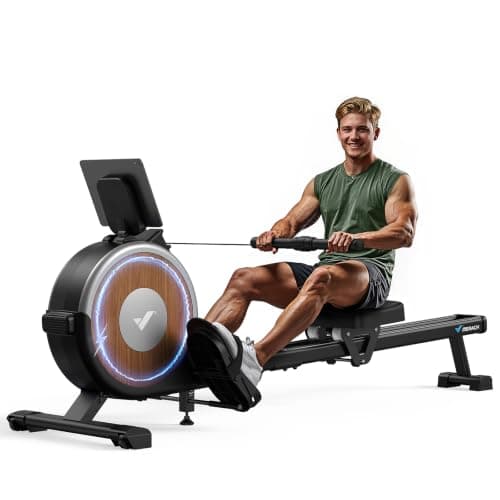
Best compact rower
Best budget rowing machines for small spaces
Compact rowers ranked on stored footprint and rail length rather than level counts, with the figures each brand publishes and the ones it does not.
Compact rowers ranked on stored footprint, rail length and resistance type — the three numbers a home rower is actually bought on.
Belt & Bike earns a commission when you buy through our links — from Amazon and from brand partner programs — at no extra cost to you. Prices change; the date beside every price is when we last verified it. Full disclosure.
Ranked on the specifications below. Prices are live and dated; where no live price resolves, the cell reads Check price.
| # | Model | Resistance | Score | Price |
|---|---|---|---|---|
| Rank 1 | MERACH Q1S Self-Powered Rower Rowing anywhere, with no power outlet | 16-level auto electromagnetic | 9.1 | $269.99Amazon |
| Rank 2 | 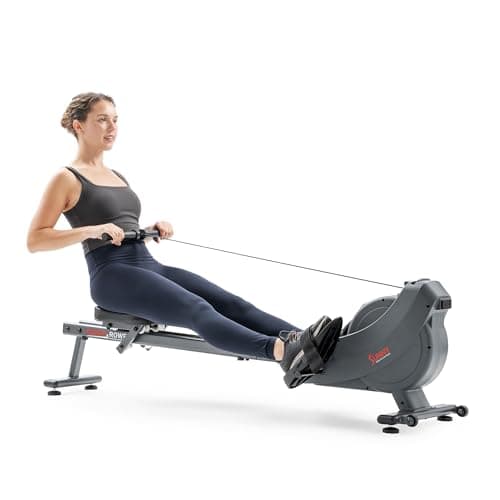 Sunny Health & Fitness Smart Dual-Rail Rower A published rail length under $200 | 16-level magnetic | 9.1 | $199.00Amazon |
| Rank 3 | 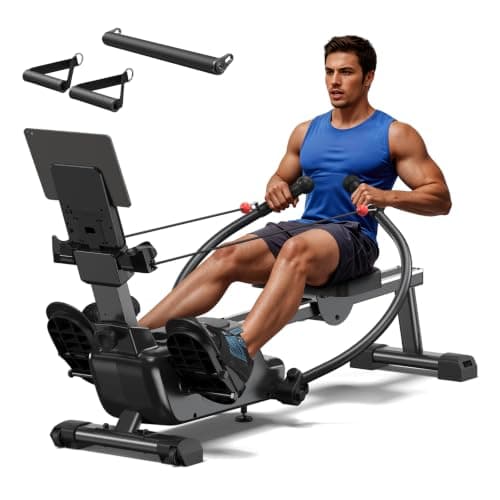 MERACH NovaRow RS3 Scull Rower Independent arms, for a stroke that matches real sculling | 16-level magnetic, up to 88 lb | 9.0 | $359.99Amazon |
| Rank 4 | 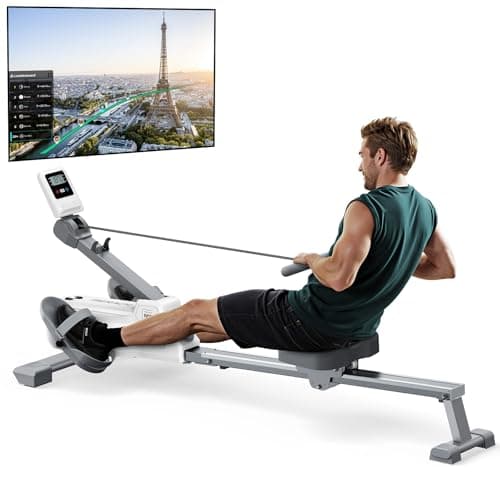 MERACH R25 Foldable Rower The cheapest rower that folds and still states a real capacity | 16-level magnetic | 8.8 | $169.99Amazon |
| Rank 5 | 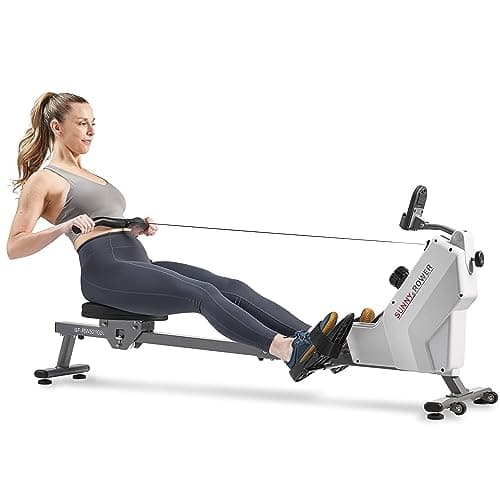 Sunny Health & Fitness Smart Compact Rower The smallest footprint from a brand that sells parts | 8-level magnetic | 8.7 | $239.99Amazon |
#ad Prices come from Amazon and change. How this site is funded. Scores are our published editorial rubric — see our methodology.
A rower is the one machine in this house that asks the whole body to work — roughly 60% legs, 30% core and back, 10% arms — and the one most often bought and then stored. This section exists because the specification that decides whether a rower keeps getting used is not its resistance type or its level count. It is how much floor it occupies when nobody is on it.
Almost every magnetic rower stands on its end, so the honest question is not whether a room fits a rower but whether it fits one stored. We rank on three published figures, in this order:
| Resistance type | Noise | How it behaves | Best for |
|---|---|---|---|
| Magnetic | Near-silent | Holds the level you set | Apartments, steady cardio |
| Electromagnetic, self-powered | Near-silent | Builds as the flywheel spins up | Rooms with no spare outlet |
| Air | Loud | Scales with your effort | Intervals, a garage or basement |
| Water | A wash, not a roar | Scales with effort | Buyers paying for the feel |
Upper body. A treadmill trains the specific adaptation to walking and running, which nothing else can substitute for, and an exercise bike is the gentlest of the three on the joints. A rower is the one that recruits the back, shoulders and arms as well as the legs, which is why it suits a household buying one machine rather than three.
It is also the one with a technique requirement. The stroke loads the lumbar spine at the catch, which is where form breaks down first. That makes it an excellent machine with good technique and a poor one without — and if you are rowing around an existing back problem, the program belongs with a clinician rather than with a product page.
What each price band buys
Most of what this site covers sits in the first three bands, because that is where the honest value is. The full ranking is in best budget rowing machines for small spaces, and the brand that appears most often in it has its own line-up page.
The machine every one of them is measured against is the Concept2 RowErg, and it is worth knowing exactly which parts of it are not purchasable for less before you spend anything. Concept2 alternatives sets Concept2's own published specifications — the 54-inch monorail, the 500 lb tested capacity, the comparable PM5 monitor — against what a budget magnetic rower actually gives you, and ranks the five that come closest on the criteria that are still open at this price.
Every rower ranked here works completely from its own monitor with no account and no monthly fee. The manufacturer apps — MERACH's and SunnyFit — are free, and several machines also broadcast to KINOMAP or Zwift if you already pay for one of those. That is the same standard this site applies to treadmills and bikes: a console function behind a paywall counts against the machine.
5 pages in this section. Roundup tiles carry the live price and a buy link for their top pick.
Best compact rower
Compact rowers ranked on stored footprint and rail length rather than level counts, with the figures each brand publishes and the ones it does not.
Best rower for bad knees
Rowing is non-impact but not low-flexion — when a rower helps a sore knee, when a recumbent is the better buy, and what to look for.
Best rower for beginners
The four-part stroke in order, then the three specs a first rower should be bought on — rail length before anything else.
Best rower under $500
Under $500 the resistance type is decided for you — this ranks what is still open: published rail length, resistance range and stored size.
Closest to a Concept2
What the RowErg's price actually buys, which parts of it are not purchasable for less, and the five budget rowers that come closest on the rest.
If you read nothing else on this page: this is the machine to buy, and this is the one to buy instead if it does not fit your space or your budget.
Buy this one
Rowing anywhere, with no power outlet
#ad How we are funded · Price as of November 18, 2026
Or this one
A published rail length under $200
#ad How we are funded · Price as of November 18, 2026