Rowers
Best rowing machine for beginners
Rowing is the machine most often bought and least often learned. Twenty minutes on the stroke order is worth more than any upgrade.
Belt & Bike earns a commission when you buy through our links — from Amazon and from brand partner programs — at no extra cost to you. Prices change; the date beside every price is when we last verified it. Full disclosure.
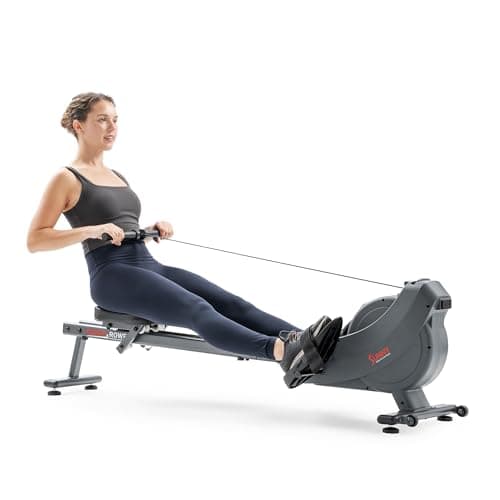
Best rower for beginners
Sunny Health & Fitness Smart Dual-Rail Rower
Sixteen magnetic levels on a published 45.7-inch dual rail with a 300 lb capacity — the budget rower that tells you the one figure that decides whether your stroke fits.
#ad How we are funded · Price as of November 18, 2026
Quick picks
| # | Model | Resistance | Score | Price |
|---|---|---|---|---|
| Rank 1 | Sunny Health & Fitness Smart Dual-Rail Rower A published rail length under $200 | 16-level magnetic | 9.1 | $199.00Amazon |
| Rank 2 | 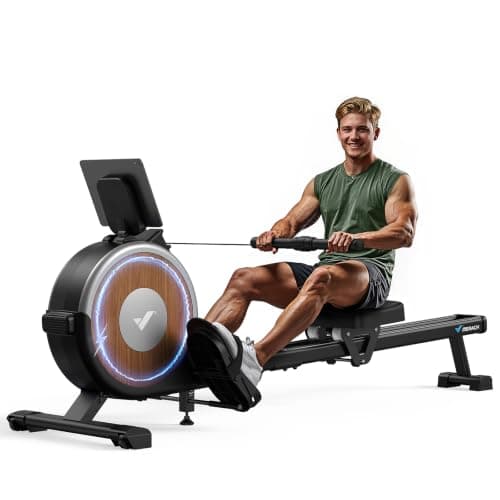 MERACH Q1S Self-Powered Rower Rowing anywhere, with no power outlet | 16-level auto electromagnetic | 9.1 | $269.99Amazon |
| Rank 3 | 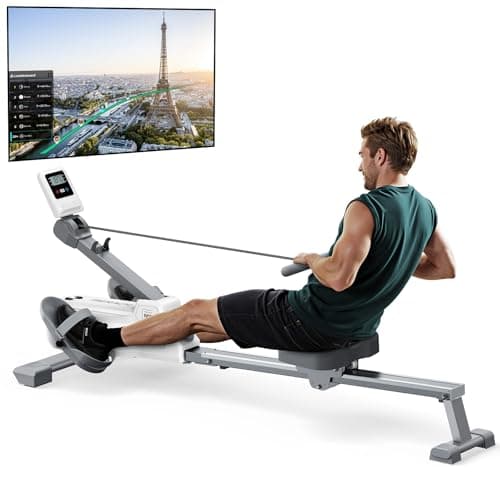 MERACH R25 Foldable Rower The cheapest rower that folds and still states a real capacity | 16-level magnetic | 8.8 | $169.99Amazon |
| Rank 4 | 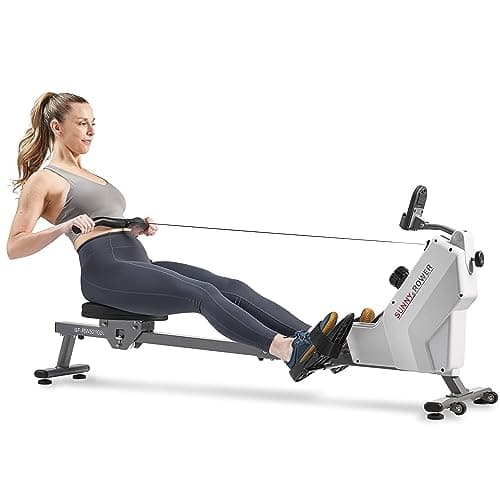 Sunny Health & Fitness Smart Compact Rower The smallest footprint from a brand that sells parts | 8-level magnetic | 8.7 | $239.99Amazon |
#ad Prices come from Amazon and change. How this site is funded. Scores are our published editorial rubric — see our methodology.
Buy the Sunny dual-rail rower. It publishes a 45.7-inch rail — the figure that decides whether your stroke fits, and the one most budget brands leave out — it gives you sixteen numbered resistance levels so a session is repeatable, and it costs under two hundred dollars. The MERACH Q1S is the alternative if you have no spare outlet where the machine will live.
Learn the stroke before you shop the spec sheet
Rowing is roughly 60% legs, 30% core and back, 10% arms, and almost every beginner reverses that by pulling with the arms first. The sequence is the whole technique:
- The catch. Shins vertical, arms straight, shoulders in front of the hips. This is the start position, not a crouch.
- The drive — legs first. Push the floor away. The arms stay straight and the back stays braced; nothing else moves yet.
- Then the body swing. Once the legs are nearly straight, the torso opens backwards to about eleven o'clock.
- Then the arms. Last, and briefest. Pull the handle to the bottom of the ribs.
- The recovery, in reverse. Arms away, then body forward, then bend the knees. Slower than the drive — about twice as long.
The three specs a first rower should be bought on
| Spec | Why it matters first | Beginner threshold |
|---|---|---|
| Rail length | Whether you reach full leg drive | 44-48″; 48″+ over 6′2″ |
| Resistance levels | Repeating a session exactly | 16 numbered levels beats 8 |
| Stored footprint | Whether it stays set up | Under 4 sq ft upright |
| Monitor | Distance, time, strokes per minute | Standalone, no account required |
| Weight capacity | Frame confidence | You + 50 lb |
The picks
#1 · A published rail length under $200
#ad How we are funded · Price as of November 18, 2026
Sunny Health & Fitness Smart Dual-Rail Rower
Sunny Health & FitnessSixteen magnetic levels on a published 45.7-inch dual rail with a 300 lb capacity — the budget rower that tells you the one figure that decides whether your stroke fits.
| Resistance | 16-level magnetic |
|---|---|
| Rail length | 45.7″, dual rail |
| Weight capacity | 300 lb |
| Storage | Stores vertically |
| App | SunnyFit, free and optional |
| Subscription | Subscription optional |
The monitor is standalone; the SunnyFit app is free and optional.
Specifications per Manufacturer figures as published on the Amazon product listing.
Why we picked it
- Publishes a rail length — the figure most budget rowers leave out
- A dual rail is steadier at the catch than a single center beam
- Sixteen numbered levels and a 300 lb capacity
- An established brand with a parts channel behind it
Good to know
A 45.7″ rail fits most adults comfortably; over about six foot two, measure your leg drive against it before ordering.
Our rubric
- Stroke
- 8.9
- Rail
- 8.9
- Resistance
- 9.3
- Build
- 8.9
- Value
- 9.8
#2 · Rowing anywhere, with no power outlet
$299.99 10% off
#ad How we are funded · Price as of November 18, 2026
MERACH Q1S Self-Powered Rower
MERACHA self-powered electromagnetic flywheel: sixteen levels of automatic resistance with no cord to reach an outlet, and a published storage footprint of 1.6 by 2.1 feet stood on end.
| Resistance | 16-level auto electromagnetic |
|---|---|
| Power | Self-powered — no mains cord |
| Weight capacity | 350 lb (manufacturer figure) |
| Space in use | 1.6 × 5.7 ft |
| Space stored | 1.6 × 2.1 ft, upright |
| Assembly | About 30 minutes |
| Subscription | Subscription optional |
Rows with no account; the MERACH app and KINOMAP support are optional.
Specifications per MERACH published specifications.
Why we picked it
- Self-powered, so the only constraint on where it lives is floor space
- Resistance changes automatically through the app as well as by knob
- Publishes both an in-use and a stored footprint, which is the figure that decides a small room
- Stores upright on built-in transport wheels
Good to know
Stored upright it takes about 1.6 by 2.1 feet — check that against the wall you have in mind, because that is the number that decides whether it stays out.
Our rubric
- Stroke
- 8.9
- Rail
- 8.4
- Resistance
- 9.3
- Build
- 8.9
- Value
- 9.8
#3 · The cheapest rower that folds and still states a real capacity
#ad How we are funded · Price as of November 18, 2026
MERACH R25 Foldable Rower
MERACHSixteen magnetic levels, a 350 lb capacity and a frame that folds to save a fifth of its footprint, for under two hundred dollars — the entry point to rowing that does not feel like a toy.
| Resistance | 16-level magnetic |
|---|---|
| Weight capacity | 350 lb (manufacturer figure) |
| Storage | Folds — saves 20% of its footprint |
| App | MERACH app, optional |
| Rail length | Not published by manufacturer |
| Subscription | Subscription optional |
The monitor works standalone; the MERACH app is free and optional.
Specifications per Manufacturer figures as published on the Amazon product listing.
Why we picked it
- Sixteen numbered magnetic levels, so a session is repeatable to the level
- A 350 lb stated capacity at a price where 250 lb is common
- Folds for storage rather than needing a dedicated corner
- Magnetic resistance has nothing in contact to wear out
Good to know
Rail length decides whether a tall rower gets a full stroke and MERACH does not publish it here — measure your own leg drive against the listing photos before ordering.
Our rubric
- Stroke
- 8.4
- Rail
- 7.9
- Resistance
- 9.3
- Build
- 8.4
- Value
- 9.8
#4 · The smallest footprint from a brand that sells parts
$329.99 27% off
#ad How we are funded · Price as of November 18, 2026
Sunny Health & Fitness Smart Compact Rower
Sunny Health & FitnessBuilt around the storage problem rather than the spec sheet: a compact frame that stands on end, a 285 lb capacity and eight magnetic levels, from a brand with a service channel.
| Resistance | 8-level magnetic |
|---|---|
| Weight capacity | 285 lb |
| Storage | Vertical, compact frame |
| Seat | Cushioned |
| App | SunnyFit, free and optional |
| Rail length | Not published by manufacturer |
| Subscription | Subscription optional |
The monitor is standalone; the SunnyFit app is free and optional.
Specifications per Manufacturer figures as published on the Amazon product listing.
Why we picked it
- Designed around a compact footprint and vertical storage
- An established brand that actually sells replacement parts
- Magnetic resistance, quiet enough for a shared wall
- Cushioned seat, which matters more on a rower than the spec sheet suggests
Good to know
Eight resistance levels is the trade for the footprint — fine for steady cardio, limiting if you want to push hard against the top of the range.
Our rubric
- Stroke
- 8.4
- Rail
- 7.9
- Resistance
- 8.9
- Build
- 8.9
- Value
- 9.3
How much to do, and how to start
Federal guidance is 150 minutes of moderate activity a week, and rowing accumulates it quickly because it recruits so much of the body per minute. The useful beginner progression is duration before intensity: four or five sessions of 10 to 15 easy minutes in the first fortnight, with the resistance low enough that you can hold the stroke order. Chase stroke rate and resistance only once the sequence is automatic.
- Strokes per minute is not the goal. 20 to 24 spm with a long, controlled recovery beats 32 spm of short, frantic pulls.
- Low resistance is correct at the start. Heavy resistance at the catch is where a beginner's back and knees get recruited wrongly.
- Use a mirror or a phone for one session. Watching your own recovery order fixes it faster than any amount of reading.
Where a rower fits against the other machines
It is the most complete of the three machines this site covers, because it recruits the upper body as well as the legs. It is also the one with a technique requirement — a treadmill asks for none, and an exercise bike asks for almost none. Treadmill vs rowing machine sets the two side by side, and exercise bike vs rowing machine does the same for the bike.
If floor space is the deciding factor rather than the stroke, best budget rowing machines for small spaces ranks on stored footprint. If a knee is the deciding factor, rowing machines for bad knees covers the catch-angle problem.
Frequently asked questions
What is the best rowing machine for beginners?
What is the correct rowing stroke order?
What is the most common beginner mistake?
How often should a beginner row?
What resistance should a beginner use?
Our recommendation
If you read nothing else on this page: this is the machine to buy, and this is the one to buy instead if it does not fit your space or your budget.
Buy this one
Sunny Health & Fitness Smart Dual-Rail Rower
A published rail length under $200
#ad How we are funded · Price as of November 18, 2026
Or this one
MERACH Q1S Self-Powered Rower
Rowing anywhere, with no power outlet
#ad How we are funded · Price as of November 18, 2026
Brands: want your product tested? For Brands.
Sources
Read next
Rowers
Best budget rowing machines for small spaces
Compact rowers ranked on stored footprint and rail length rather than level counts, with the figures each brand publishes and the ones it does not.
Rowers
Best rowing machines under $500
Under $500 the resistance type is decided for you — this ranks what is still open: published rail length, resistance range and stored size.
Rowers
Concept2 alternatives: what gets closest, and what you give up
What the RowErg's price actually buys, which parts of it are not purchasable for less, and the five budget rowers that come closest on the rest.
Rowers
Best rowing machine for bad knees
Rowing is non-impact but not low-flexion — when a rower helps a sore knee, when a recumbent is the better buy, and what to look for.
Compare
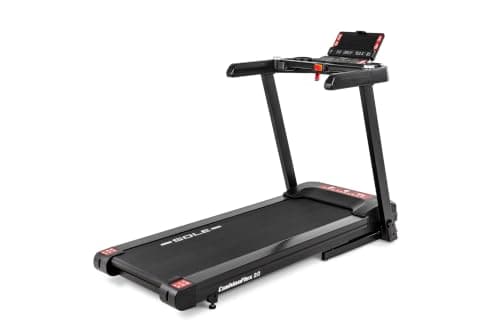
Treadmill vs rowing machine
Impact, muscle recruited, footprint and technique — the four differences that decide it, with ranked picks on both sides.
Guides
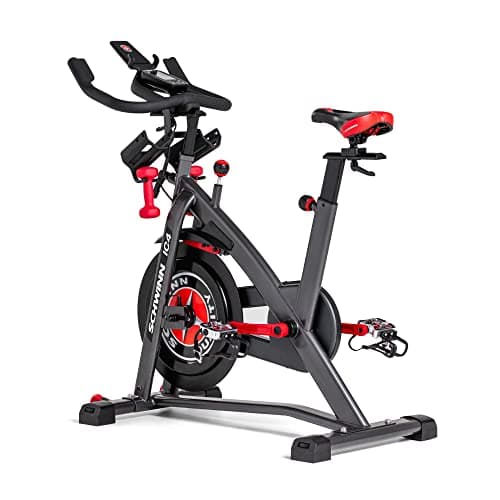
Choosing your first home cardio machine
Three budgets, five questions, and why the first machine should be cheap enough to be wrong about.