Guides
Exercise bike resistance types explained
Three mechanisms, three completely different ownership experiences. The choice matters more than the brand.
Belt & Bike earns a commission when you buy through our links, at no extra cost to you. Prices come from Amazon and change; the date beside every price is when we last verified it. Full disclosure.
Quick picks
| # | Model | Resistance | Score | Price |
|---|---|---|---|---|
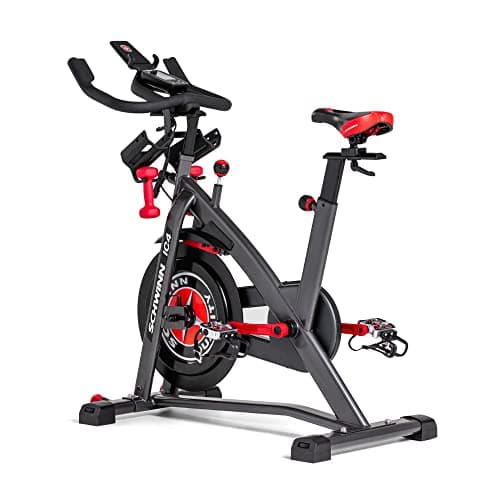
| Rank 1 | Schwinn IC4 A Peloton ride feel with no Peloton bill | 100-level magnetic | 9.0 | $795.99Amazon |
| Rank 2 | 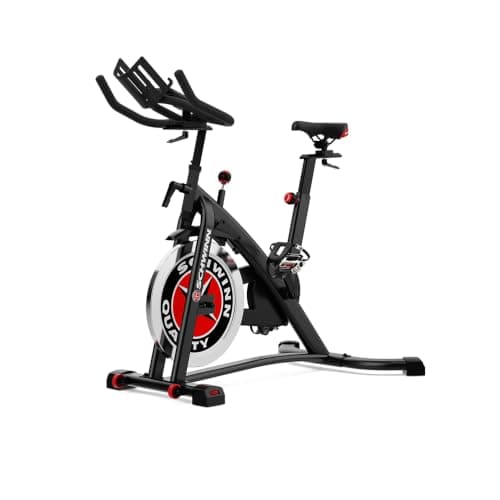 Schwinn IC3 The same flywheel, two hundred dollars cheaper | Infinite-variable friction (felt pad) | 7.8 | $599.99Amazon |
| Rank 3 | 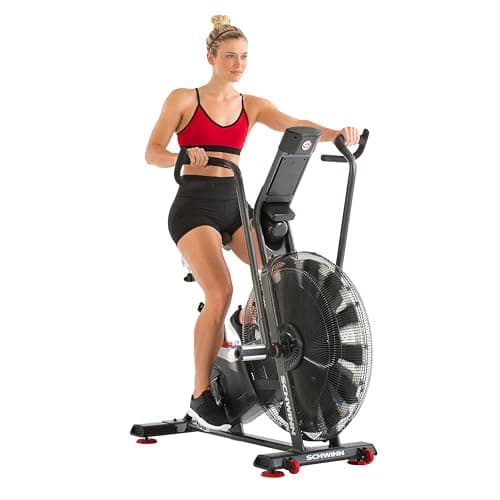 Schwinn Airdyne AD7 A belt-drive air bike that stays quiet | Unlimited air (fan) | 8.4 | $999.99Amazon |
| Rank 4 | 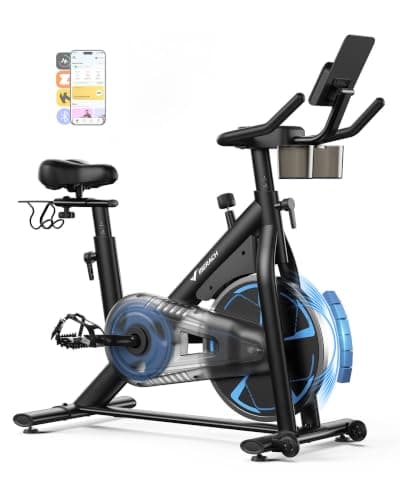 MERACH S36 Magnetic resistance and a 330 lb rating under $300 | Magnetic | 7.2 | $279.99Amazon |
#ad Prices come from Amazon and change. How this site is funded. Scores are our published editorial rubric — see our methodology.
An exercise bike's resistance mechanism determines how quiet it is, whether it has a wear part, whether you can repeat a workout, and how it ages. It matters considerably more than which brand is on the frame.
Magnetic resistance
Magnets are moved closer to or further from the spinning flywheel. The changing magnetic field induces eddy currents in the metal, which oppose the motion. Nothing touches anything.
- Near-silent. The only sound is the drive belt and the bearings.
- No wear part. There is nothing in the resistance path to replace.
- Often numbered. The mechanism lends itself to discrete, repeatable levels.
- Consistent. It does not fade as it warms or change when damp.
- The downside: if the resistance unit itself fails on a budget bike, it is usually not replaceable.
Eddy-current versus simple magnetic
At the studio end — the Keiser M3i is the example — the magnetic system is engineered specifically as an eddy-current brake with very fine, linear control and no detents. Budget magnetic systems are cruder: fewer positions, less even ramping. Both are magnetic; they are not equivalent.
Friction resistance
A felt or leather pad presses against the flywheel. Simple, old, effective.
- Audible hiss, rising with pressure. Squeaks when damp.
- A wear part — the pad erodes and needs replacing, typically every one to two years under heavy use.
- Usually unmarked. A knob, not a dial, so sessions are not precisely repeatable.
- Fades as it warms, so resistance drifts slightly within a long session.
- The upside, and it is real: every part is a cheap, universally available replacement. A friction bike can last indefinitely.
Air (fan) resistance
A fan replaces the flywheel. Resistance rises with roughly the square of pedal speed. See the air bike buying guide.
- Unlimited and self-scaling. No setting at all.
- Loud. The resistance mechanism is moving air.
- Nothing to wear in the resistance path.
- Vague at low effort, superb at maximal effort.
Side by side
| Magnetic | Friction | Air | |
|---|---|---|---|
| Noise | Near-silent | Audible hiss | Loud |
| Wear part | None | Felt pad | None |
| Repeatable levels | Usually | No | N/A |
| Consistency | High | Fades when warm | Perfectly consistent |
| Repairability | Poor on budget bikes | Excellent | Good |
| Best for | Almost everyone | Long-term ownership | Intervals |
| Apartment friendly | Yes | Mostly | No |
Which to buy
- Magnetic for almost everyone. Quiet, repeatable, no wear.
- Friction if long-term repairability genuinely matters to you and noise does not.
- Air if your training is short maximal intervals and the machine lives somewhere it can be loud.
One bike per resistance type
#1 · A Peloton ride feel with no Peloton bill
#ad How we are funded · Price as of October 5, 2026
Schwinn IC4
Schwinn FitnessA 40 lb flywheel with 100 levels of magnetic resistance and open Bluetooth — it rides like the subscription bikes and connects to whichever app you choose, including none.
| Flywheel | 40 lb |
|---|---|
| Resistance | 100-level magnetic |
| Weight capacity | 330 lb |
| Console | Backlit color LCD: HR, speed, time, distance, calories, RPM |
| App support | JRNY, Peloton, Zwift via Bluetooth |
| Pedals | Dual-sided: toe cage and SPD |
| Subscription | No subscription |
Nothing is gated. JRNY is optional, and the bike's Bluetooth broadcast works with Peloton, Zwift or no app at all — every console metric is on the bike itself.
Specifications per Schwinn Fitness published specifications.
What it does well
- 100 discrete magnetic levels mean you can repeat a workout exactly — friction bikes cannot
- Broadcasts cadence and speed over Bluetooth to any app, so you are not locked to one ecosystem
- Dual-sided pedals work with trainers or cycling shoes out of the box
- 330 lb capacity is above the class norm
Where it falls short
- No screen — you supply a tablet, which the included holder expects
- Resistance is a knob, not an app-controlled servo, so classes cannot auto-adjust it
- The most expensive bike here that is not a studio machine
Our rubric
- Ride
- 9.0
- Fit
- 9.0
- Resistance
- 10.0
- Build
- 9.0
- Value
- 8.0
#2 · The same flywheel, two hundred dollars cheaper
Schwinn IC3
Schwinn FitnessThe IC4's 40 lb flywheel on a friction brake instead of magnets — same ride weight, less repeatability, noticeably less money.
| Flywheel | 40 lb |
|---|---|
| Resistance | Infinite-variable friction (felt pad) |
| Weight capacity | 300 lb |
| Drive | Belt |
| Console | LCD |
| Subscription | No subscription |
There is nothing to subscribe to. The console is self-contained.
Specifications per Schwinn Fitness published specifications.
What it does well
- Identical 40 lb flywheel to the IC4 — the ride momentum is the same
- Belt drive is quiet despite the friction brake
- Significantly cheaper than the IC4
Where it falls short
- Friction pads wear and need replacing; magnets never touch anything
- No numbered levels, so you cannot repeat a workout precisely
- No Bluetooth broadcast — your app cannot see your cadence
Our rubric
- Ride
- 8.0
- Fit
- 8.0
- Resistance
- 6.0
- Build
- 8.0
- Value
- 9.0
#3 · A belt-drive air bike that stays quiet
Schwinn Airdyne AD7
Schwinn FitnessThe air bike with a belt instead of a chain — quieter, smoother and far less maintenance than the chain-driven competition, with a 350 lb rating.
| Resistance | Unlimited air (fan) |
|---|---|
| Drive | Belt (first on an air bike) |
| Weight capacity | 350 lb |
| Footprint | 53″ L × 26.5″ W × 53″ H |
| Machine weight | 113 lb |
| Subscription | No subscription |
A fan, a belt and an LCD. There is nothing to subscribe to.
Specifications per Schwinn Fitness published specifications.
What it does well
- Belt drive removes chain stretch, lubrication and the loudest part of an air bike
- 350 lb capacity and a heavy frame that does not shift under a sprint
- Air resistance is self-scaling: it is exactly as hard as you pedal
Where it falls short
- Air bikes are loud by nature — belt drive helps, the fan still roars
- No magnetic option, so low-intensity work feels vague
- Nearly a thousand dollars, and it does not fold or move easily
Our rubric
- Ride
- 9.0
- Fit
- 8.0
- Resistance
- 8.0
- Build
- 10.0
- Value
- 7.0
#4 · Magnetic resistance and a 330 lb rating under $300
MERACH S36
MERACHMagnetic resistance, a 330 lb stated capacity and a sub-$300 price — the spec sheet that made MERACH a serious budget name.
| Resistance | Magnetic |
|---|---|
| Weight capacity | 330 lb (manufacturer figure) |
| Flywheel | Not published by manufacturer |
| Console | LCD with app connectivity |
| Subscription | Subscription optional |
The MERACH app is free and optional; the bike works with no account.
Specifications per Manufacturer figures as published on the Amazon product listing.
What it does well
- 330 lb rating at a price where 265 lb is common
- Magnetic resistance with no wear pad
- App connectivity included but not required
Where it falls short
- No published flywheel weight
- Resistance knob is unnumbered
- No established parts channel
Our rubric
- Ride
- 7.0
- Fit
- 7.0
- Resistance
- 7.0
- Build
- 6.0
- Value
- 9.0
Frequently asked questions
What is the best resistance type for an exercise bike?
How does magnetic resistance work on an exercise bike?
Is friction resistance bad?
How often do you replace a friction brake pad?
Why do air bikes have no resistance levels?
Sources
Read next
Guides
Exercise bike buying guide
Format, then resistance, then fit — the three decisions in the order that matters.
Guides
Exercise bike flywheel weight explained
What the flywheel actually does, where the useful range ends, and why position beats weight.
Guides
Air bike buying guide
The square law that explains everything about fan resistance, and the three specs that matter.
Exercise Bikes
Best exercise bikes under $300
The bracket where a bike beats a treadmill outright, and the one spec that decides it.
Guides
Spin bike drive systems: belt vs chain
A noise and maintenance decision, not a performance one — and what it does not affect.