Guides
Treadmill troubleshooting
Most treadmill faults have three or four likely causes. Here they are, in the order worth checking.
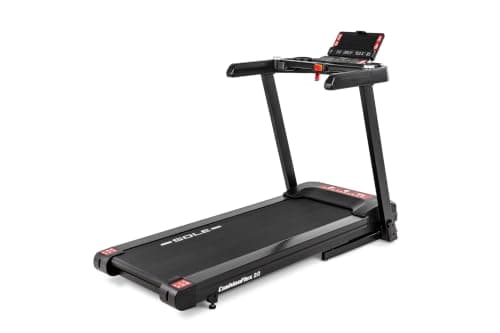
This page is deliberately unmonetized. If your treadmill smells of burning, you need a diagnosis, not a product recommendation.
The belt slips or hesitates under your foot
- Belt tension. Lift the belt at the center edge — it should rise two to three inches. If it rises much more, tighten the rear roller bolts a quarter turn each, evenly, and retest.
- Deck lubrication. A dry deck causes drag that presents as hesitation. Check and lubricate per treadmill maintenance.
- Drive belt slipping inside the motor cowl. Unplug, remove the cover, check for glazing or slack.
- Motor undersized for your use. If this appears under a heavier user at pace on a budget machine, the motor is at its limit.
The belt drifts to one side
Normal and adjustable. Rear roller bolts, a quarter turn at a time: drifting right means tighten the right bolt slightly. Run at low speed, observe for a minute, adjust again if needed. Also check the machine is level — an unlevel floor causes persistent drift that no amount of adjustment fixes.
Burning smell
- New machine, first few hours: often the motor's protective coating curing off. It should disappear and never return.
- Any other time: stop immediately and unplug. Likely causes are a dry deck causing extreme friction, a motor being driven beyond its rating, or an electrical fault.
- Check the deck lubrication before anything else. It is by far the most common cause.
- If the smell persists after lubrication, or there is any smoke, stop using the machine and contact the manufacturer.
Rising whine, grinding or knocking
| Noise | Likely cause | Action |
|---|---|---|
| Rising-pitch whine with speed | Motor bearing or motor under strain | Check deck lubrication; if unchanged, service |
| Rhythmic knocking matching belt speed | Belt seam or a flat spot on a roller | Inspect the belt; replace if seam-damaged |
| Grinding from the front | Front roller bearing | Needs replacement — parts channel matters here |
| Squeak at footstrike | Deck or frame bolt | Check and tighten all frame bolts |
| Clicking at the rear | Rear roller bearing or debris | Unplug, inspect, clear debris |
The incline will not move
- Run the calibration routine in your manual. Many incline faults are a lost position reference, not a failure.
- Check for obstruction under the frame.
- Listen. A motor that hums without moving is usually jammed or has a failed lift nut. A silent motor is usually an electrical fault.
- On connected machines, check whether auto-incline is a subscription feature — if your trial ended, the manual controls will still work but the automatic ones may not.
Error codes
Error codes are manufacturer-specific and the same code means different things on different brands. We are not going to publish a generic lookup table, because a wrong diagnosis on an electrical fault is worse than no diagnosis. Find your model's manual — most manufacturers publish them as free PDFs — and look the code up there.
The breaker trips
Treadmills draw substantial startup current. Check it is on its own circuit and not sharing with a space heater or a microwave. Never use an extension cord — the voltage drop increases current draw and the cord can overheat. If it trips on a dedicated circuit, the machine has an electrical fault and needs a technician.
When to stop and call someone
- Any smoke, or a burning smell that persists after lubrication.
- A repeatedly tripping breaker on a dedicated circuit.
- The belt moving when the machine is off.
- Any crack in the frame or the deck board.
- Anything involving the controller board — mains voltages, stored charge, and a part that is expensive to get wrong.
Frequently asked questions
Why does my treadmill belt slip when I step on it?
Why does my treadmill smell like burning?
How do I stop my treadmill belt drifting to one side?
Why does my treadmill trip the circuit breaker?
Can I fix a treadmill error code myself?
Sources
Read next
Guides
Treadmill maintenance
Four tasks, a realistic schedule, and the lubrication mistake that kills motors.
Guides
How long do treadmills last?
What fails, in what order, and the four things that genuinely change the odds.
Guides
How much horsepower should a treadmill have?
CHP versus peak HP, the thresholds by weight and use, and why headroom beats the minimum.
Guides
Treadmill deck cushioning explained
How cushioning works, why variable-zone is the right design, and why softer is not better.
Hub
Home treadmills, judged on the machine
Motor, deck, incline and warranty. Ranked on the four specs that decide whether a treadmill survives, with live prices.