Exercise Bikes
Best exercise bikes with a screen you are not renting
Three different products are sold as “a bike with a screen”. Only one of them keeps working when you stop paying.
Belt & Bike earns a commission when you buy through our links — from Amazon and from brand partner programs — at no extra cost to you. Prices change; the date beside every price is when we last verified it. Full disclosure.
Best bike with a screen
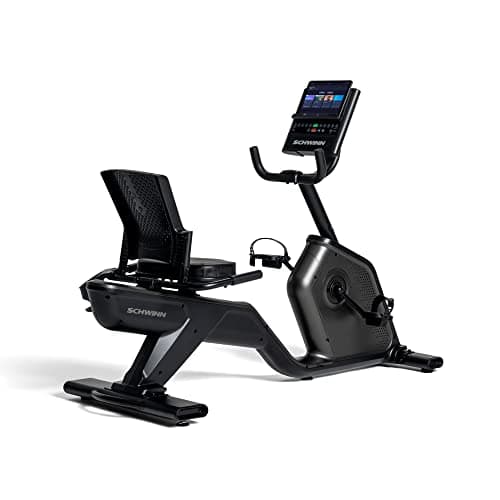
Schwinn 290 Recumbent Bike
25 magnetic levels, a 330 lb rating and full FTMS Bluetooth — the recumbent to buy if you will genuinely outgrow sixteen levels and you have 66 inches of floor.
#ad How we are funded · Price as of November 18, 2026
Quick picks
| # | Model | Console | Score | Price |
|---|---|---|---|---|
| Rank 1 | Schwinn 290 Recumbent Bike The widest resistance range in a step-through frame | 7″ LCD, full FTMS, USB charging | 9.3 | $799.00Amazon |
| Rank 2 | 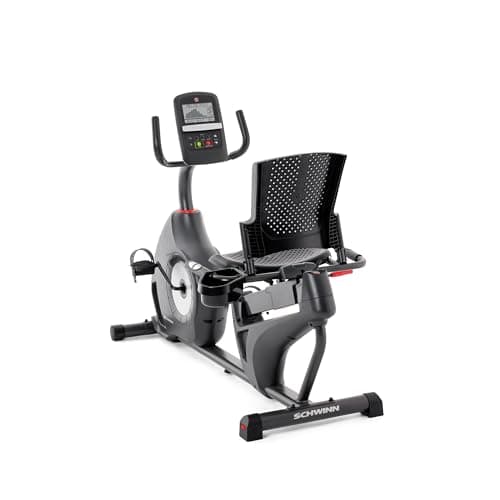 Schwinn 230 Recumbent Bike A branded recumbent with real parts support | LCD, Bluetooth (partial FTMS) | 9.3 | $499.99Amazon |
| Rank 3 | 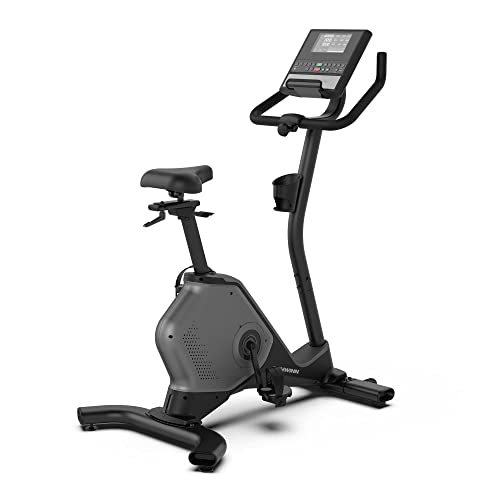 Schwinn 190 Upright Bike 25 levels and 330 lb in an upright frame | Large LCD, full FTMS, USB charging | 9.2 | $699.99Amazon |
| Rank 4 | 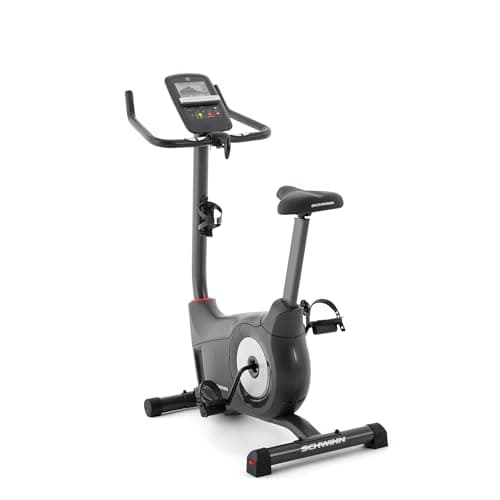 Schwinn 130 Upright Bike A compact upright from a real brand | Streamlined LCD, partial FTMS | 9.1 | $399.99Amazon |
| Rank 5 | 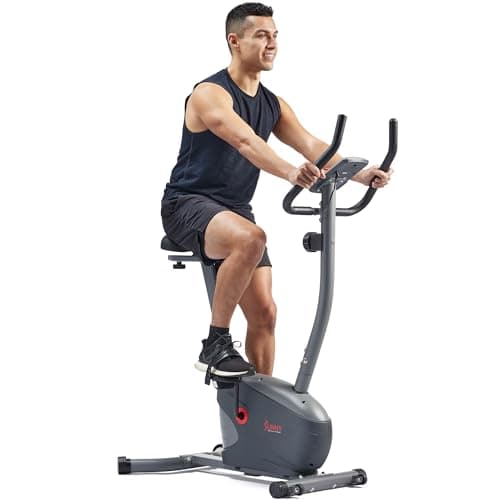 Sunny Health & Fitness Smart Upright Bike A beginner upright under $250 | LCD, app-connectable | 8.8 | $249.99Amazon |
#ad Prices come from Amazon and change. How this site is funded. Scores are our published editorial rubric — see our methodology.
“Exercise bike with a screen” is one of the few searches in home cardio where the words do not narrow the field at all. Three completely different products answer to it: a bike with a built-in display that works forever, a bike with a shelf where your own tablet goes, and a bike with a touchscreen whose content is a monthly bill. They cost different money, they fail in different ways, and only the third one can stop working while the bike itself is still perfectly fine.
This page ranks the first kind, because it is the kind most people searching for a screen actually want and the kind almost nobody writes about. Every bike below has a console figure published by the manufacturer or on the product listing, and not one of them gates a readout, a resistance level or a metric behind a paid plan. The other two routes are legitimate, and we set out both further down — including which bikes we would buy if you want them.
The three things “a screen” can mean
Pick your route before you pick a bike
- A display that shows my numbersA built-in LCD console. Works with no account, forever. The ranking below.
- A screen for classes and videoA tablet holder plus the device you already own. Cheaper, replaceable, yours. See the picks
- A touchscreen with classes built inA subscription bike. Real product, real monthly cost — price it over three years first. See the picks
The distinction matters because the word “screen” is doing two jobs. On a mid-hundreds bike it means a backlit panel that counts your revolutions, your time and your heart rate. On a four-figure bike it means a tablet bolted to the handlebars that shows an instructor, and the instructor is a service you rent. Both are screens. Only one of them is part of the bike you bought.
The four criteria, in the order they should decide your purchase
- Does every readout work with no account? This is the first question and the hardest to answer from a product listing, because a bike designed around an app will describe its display without ever saying what the display does offline. The test is simple: if the specification sheet names the metrics — time, distance, calories, rpm, heart rate — the console computes them itself. If it only names the app, the console may be a window into the app.
- Is the display figure published at all? Exactly one bike in this ranking publishes a screen size. Schwinn lists a 7″ LCD on the 290; every other machine here is described as an LCD without a dimension, which is normal in this bracket and worth knowing before you build an expectation around it. A manufacturer that publishes the number is telling you it is a specification rather than a decoration.
- Does it broadcast what it measures? A console that keeps its numbers to itself is a dead end the moment you want to log a session. Full FTMS — the Bluetooth fitness-machine standard — lets a third-party app read cadence, resistance and power from the bike itself. Partial FTMS usually means cadence and heart rate only. Resistance types explained covers why a numbered magnetic unit is what makes any of this repeatable.
- Is there power for the device? If you intend to use a tablet for anything, a USB charging port on the console is the difference between a 45-minute session and a cable run across the floor. Two bikes here publish one, and it is the most overlooked useful spec in the category.
Notice what is not on that list. Screen size is not a criterion, because the number of inches on a bike console has no relationship to how useful the readout is — a crisp small panel showing six metrics beats a dim large one showing three. Touch is not a criterion either: you will press perhaps four buttons during a ride, and physical buttons work with sweaty hands in a way a capacitive panel does not. And color depth is irrelevant, because the figure you look at most is your cadence, and cadence is a two-digit number.
The ranking
Ranked on what the console computes and publishes on its own, with Bluetooth output as the tiebreak.
#1 · The widest resistance range in a step-through frame
$899.99 11% off
#ad How we are funded · Price as of November 18, 2026
Schwinn 290 Recumbent Bike
Schwinn Fitness25 magnetic levels, a 330 lb rating and full FTMS Bluetooth — the recumbent to buy if you will genuinely outgrow sixteen levels and you have 66 inches of floor.
| Resistance | 25-level magnetic |
|---|---|
| Weight capacity | 330 lb |
| Footprint | 66.4″ L × 28″ W × 47″ H |
| Machine weight | 107.6 lb |
| Console | 7″ LCD, full FTMS, USB charging |
| Subscription | No subscription |
All 25 levels and 13 programs run with no account. JRNY adds guided content only, at Schwinn's published $11.99/mo or $99/yr.
Specifications per Schwinn Fitness published specifications.
Why we picked it
- 25 numbered magnetic levels — the widest range Schwinn publishes on a recumbent
- 330 lb capacity on a 107.6 lb frame, and both figures are published
- Full FTMS Bluetooth plus a built-in USB charging port, neither of which the 230 has
Good to know
66.4″ long, 107.6 lb, and it does not fold.
Our rubric
- Ride
- 9.3
- Fit
- 9.3
- Resistance
- 9.8
- Build
- 9.3
- Value
- 8.9
#2 · A branded recumbent with real parts support
$599.00 17% off
#ad How we are funded · Price as of November 18, 2026
Schwinn 230 Recumbent Bike
Schwinn Fitness16 magnetic resistance levels, a 300 lb rating and a proper step-through frame from a brand that still sells parts — the safe recumbent choice.
| Resistance | 16-level magnetic |
|---|---|
| Weight capacity | 300 lb |
| Footprint | 64″ L × 27.7″ W × 44″ H |
| Machine weight | 81.6 lb |
| Console | LCD, Bluetooth (partial FTMS) |
| Subscription | No subscription |
Every console function works with no account. Bluetooth is optional.
Specifications per Schwinn Fitness published specifications.
Why we picked it
- Numbered magnetic levels, so sessions are repeatable
- Step-through frame with a low entry height
- Bluetooth to the Schwinn and third-party apps — no plan required
Good to know
64″ long is a serious footprint for a bike — measure the wall first.
Our rubric
- Ride
- 9.3
- Fit
- 9.3
- Resistance
- 9.3
- Build
- 9.3
- Value
- 9.3
#3 · 25 levels and 330 lb in an upright frame
#ad How we are funded · Price as of November 18, 2026
Schwinn 190 Upright Bike
Schwinn FitnessThe 130 with nine more resistance levels, 4-way handlebars, full FTMS and a USB port — a real step up that costs a real step up, and 11 inches wider.
| Resistance | 25-level magnetic |
|---|---|
| Weight capacity | 330 lb |
| Footprint | 47″ L × 32.3″ W × 56.8″ H |
| Machine weight | 80.7 lb |
| Console | Large LCD, full FTMS, USB charging |
| Subscription | No subscription |
All 25 levels and 13 programs work with no account. JRNY is optional guided content at Schwinn's published $11.99/mo or $99/yr.
Specifications per Schwinn Fitness published specifications.
Why we picked it
- 25 numbered levels against the 130's 16, from the same published warranty
- 4-way adjustable handlebars — the 130's are fixed
- 330 lb capacity and full FTMS Bluetooth, both published
Good to know
32.3″ wide against the 130's 21.4″ — it trades the 130's footprint for the fan.
Our rubric
- Ride
- 9.3
- Fit
- 9.3
- Resistance
- 9.8
- Build
- 9.3
- Value
- 8.4
#4 · A compact upright from a real brand
$499.00 20% off
#ad How we are funded · Price as of November 18, 2026
Schwinn 130 Upright Bike
Schwinn Fitness16 magnetic levels in a 41″ × 21″ footprint — the upright to buy when the recumbent simply will not fit.
| Resistance | 16-level magnetic |
|---|---|
| Weight capacity | 300 lb |
| Footprint | 41.3″ L × 21.4″ W × 54.5″ H |
| Machine weight | 58.4 lb |
| Console | Streamlined LCD, partial FTMS |
| Subscription | No subscription |
Self-contained console; no plan to buy.
Specifications per Schwinn Fitness published specifications.
Why we picked it
- A genuinely small footprint — under two feet wide
- 58 lb means one person can move it
- Numbered magnetic resistance at an entry price
Good to know
Upright seating is less comfortable than recumbent for long sessions.
Our rubric
- Ride
- 8.9
- Fit
- 8.9
- Resistance
- 9.3
- Build
- 8.9
- Value
- 9.3
#5 · A beginner upright under $250
#ad How we are funded · Price as of November 18, 2026
Sunny Health & Fitness Smart Upright Bike
Sunny Health & FitnessA small, quiet magnetic upright aimed squarely at people starting out — enough bike to build a habit on, and no more.
| Resistance | 8-level magnetic |
|---|---|
| Form | Upright |
| Seat | 4-way adjustable |
| Weight capacity | Not published by manufacturer |
| Console | LCD, app-connectable |
| Subscription | Subscription optional |
SunnyFit optional and free at the base tier.
Specifications per Manufacturer figures as published on the Amazon product listing.
Why we picked it
- Compact and light; fits in a bedroom corner
- Magnetic resistance is quiet enough for shared walls
- 4-way seat adjustment at a price where 2-way is normal
Good to know
Eight resistance levels is a low ceiling — a strong rider will top it out.
Our rubric
- Ride
- 8.4
- Fit
- 8.9
- Resistance
- 8.4
- Build
- 8.4
- Value
- 9.8
What a built-in console actually gives you
A home bike console is a small computer doing five jobs: counting pedal revolutions, timing the session, integrating distance from those two, estimating calories from a formula, and reading a heart-rate signal if you give it one. All five work without an internet connection, because all five are arithmetic on a sensor the bike already has. That is why a plain LCD outlives a touchscreen — there is nothing in it to deprecate.
What it will not do is store history in a useful way. Budget consoles typically remember the current session and nothing else, which is the real reason to care about Bluetooth output: not because an app makes the ride better, but because an app is where a year of rides can live. The Schwinn machines here that publish full FTMS can hand that data to whichever app you pick, including free ones, and you can change your mind every January without changing your bike.
Calorie figures from any of these consoles are estimates built from a generic formula, and they read high. Treat them as a consistency measure rather than a measurement: the same number on the same bike at the same effort means you did the same work, which is all you need from it. For whether the sessions are worth the machine at all, is an exercise bike worth it works through the honest version of that question.
The tablet route, and why good bikes deliberately choose it
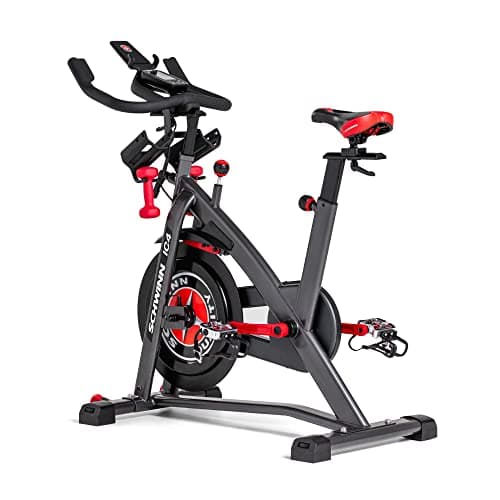
Some of the best bikes on this site ship with no display worth the name, and that is a design decision rather than a cost saving. The Schwinn IC4 gives you a backlit console for your metrics and a holder for your own device; the Keiser M3i, the bike commercial studios actually buy, does the same at several times the price. Both brands made the same call — the component that ages fastest on a connected bike is the screen, so do not weld one on.
The arithmetic is hard to argue with. A tablet you already own costs nothing, a replacement costs a fraction of a bike, and it runs whichever app you choose this year. A built-in touchscreen cannot be upgraded, is the most expensive component to replace out of warranty, and in several cases is the part that decides whether the bike is useful at all. If classes are what you want, our Schwinn IC4 review sets out what open Bluetooth buys you, and Peloton alternatives without a subscription ranks the bikes that ride like a studio machine without the bill.
When the screen is the subscription
The third route is a bike built around a paid plan, and it needs stating plainly rather than dismissively. A NordicTrack G LE is an iFIT bike: the console is designed for guided content, and the guided content — the thing the screen exists to show — requires a membership. An Echelon Smart Connect is a competent 32-level magnetic bike whose proposition is the Echelon class library, and on that model the handlebars carry a device holder rather than a built-in display at all. Neither is a bad machine. Both are bundles, and a bundle should be priced as one. The same question on the treadmill side is worked through in Peloton treadmill alternatives, where the screen is welded to a machine that costs several times as much.
| Route | What the display costs | If you stop paying | What ages first |
|---|---|---|---|
| Built-in LCD console | Included in the bike | Nothing — every readout keeps working | Nothing; it is arithmetic |
| Tablet holder + your device | You already own it | Nothing; change the app | The tablet, replaceable for a fraction of the bike |
| Built-in touchscreen + plan | Bike price plus a monthly fee | The classes stop; the bike still pedals | The screen, which cannot be upgraded |
The number that decides it is not the bike price. At a representative $39 a month, three years of membership comes to more than any bike in the ranking above costs — which is why we ask people to run the multiplication before the purchase rather than after. The subscription cost calculator does it for any monthly figure, and subscription costs explained covers what the fees actually buy.
Full FTMS versus “Bluetooth”
“Bluetooth enabled” on a bike listing can mean anything from a full data stream to a heart-rate pairing, and the difference decides whether your rides are recordable. Full FTMS means the bike publishes cadence, resistance level and estimated power in a standard any app can read. Partial FTMS normally means cadence and heart rate, with resistance left for you to note yourself. Proprietary Bluetooth means the brand's own app and nothing else.
- Full FTMS — Schwinn 290, Schwinn 190. Schwinn publishes full FTMS on both, and both add a USB charging port. These are the two bikes here that work properly with a tablet.
- Partial FTMS — Schwinn 230, Schwinn 130. The console is complete on its own and the broadcast is narrower. Fine if an app is a nice-to-have rather than the point.
- App-connectable — Sunny Smart Upright. Sunny publishes an LCD with app connectivity and a free app; the console computes its own metrics, so the app is genuinely optional.
One habit is worth more than any of this detail: before you buy, find the sentence on the listing that says what the console does with no app. If the listing cannot produce that sentence, assume the answer is less than you hoped and price it accordingly.
Format, because the display does not choose the bike
Four of the five bikes here come from the same Schwinn line, which is not a coincidence: Schwinn is the brand in this price band that publishes console specifications at all. That means the display decision and the format decision are separate, and the format one matters more for whether you ride. The 290 and 230 are step-through recumbents with backrests and a 64- to 66-inch footprint. The 190 and 130 are uprights that take roughly a third of the floor area. The Sunny is a compact beginner upright.
Decide the format first, on the basis of your body and your room, then take the best published console inside it. Upright vs recumbent bike works that decision through properly, recumbent bikes and upright exercise bikes rank each field in full, and exercise bikes for small spaces is the page to start on if floor area is the binding constraint.
What the screen cannot fix
A console does not change the ride. Seat comfort, resistance range and frame rigidity decide whether the bike is still being used in March, and none of the three is affected by what the display does. The most common way a screen purchase goes wrong is buying a worse bike with a better panel — nine resistance levels and a handsome display will stop being enough long before sixteen levels and a plain one will.
The second most common way is buying a screen to solve a motivation problem. If what is actually missing is a reason to get on the bike three times a week, a display will not supply it and neither will a class library after the first month. What tends to work is a bike that is comfortable, in a room you walk past, with a session short enough that you do not negotiate with yourself about it. Exercise bike seat comfort and bike setup and seat height between them fix more adherence problems than any console ever has.
Frequently asked questions
Which exercise bikes have a screen that works without a subscription?
Is an exercise bike with a built-in screen worth it?
What size screen do you need on an exercise bike?
Can you watch Netflix on an exercise bike screen?
What is FTMS and does it matter?
Do you need a USB port on an exercise bike?
Are touchscreen exercise bikes better than LCD ones?
Our recommendation
If you read nothing else on this page: this is the machine to buy, and this is the one to buy instead if it does not fit your space or your budget.
Buy this one
Schwinn 290 Recumbent Bike
The widest resistance range in a step-through frame
#ad How we are funded · Price as of November 18, 2026
Or this one
Schwinn 230 Recumbent Bike
A branded recumbent with real parts support
#ad How we are funded · Price as of November 18, 2026
Brands: want your product tested? For Brands.
Sources
Read next
No Subscription
Best exercise bikes without a subscription
On a bike a subscription sells content, not function — so buy the one that broadcasts open data.
Exercise Bikes
Best upright exercise bikes
Smaller than a recumbent, gentler than a spin bike, and the only one that fits in a corner.
Exercise Bikes
Best recumbent exercise bikes
The most comfortable cardio machine made, and the one most likely to still be used in month six.
Exercise Bikes
Schwinn 290 recumbent bike review
Schwinn's current top recumbent — 25 levels, 330 lb and full FTMS, with an honest account of when the cheaper 230 is the better buy.
Guides
Fitness equipment subscription costs explained
The three tiers, the TCO formula, and the four questions to ask before any connected purchase.
No Subscription
Subscription cost calculator
Purchase price plus membership over 12, 24, 36 and 60 months — with the break-even method.